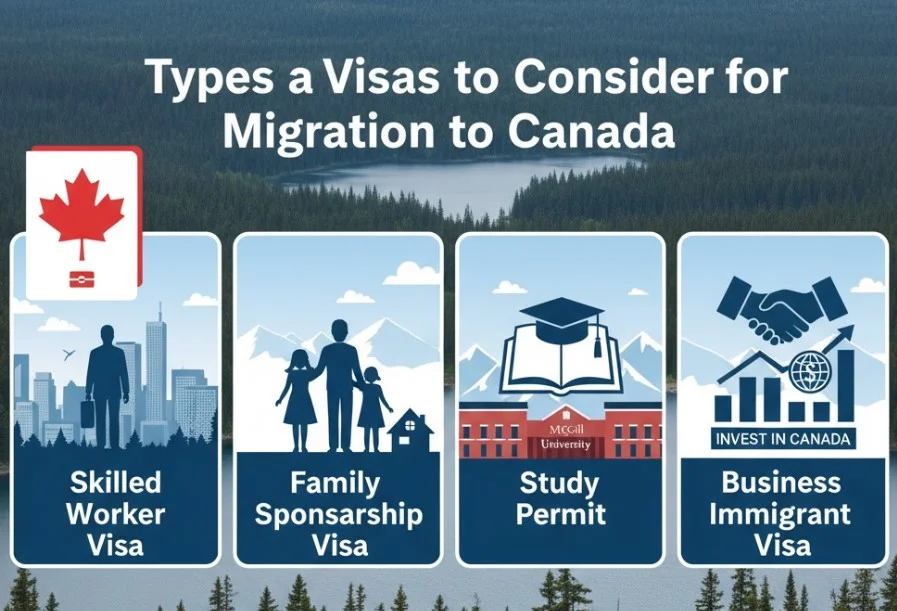
Successfully achieving migration to Canada hinges on understanding the specific requirements and eligibility criteria for each visa program.
From skilled worker streams designed to fill labor market gaps to family sponsorship programs that unite loved ones, and even entrepreneurial pathways for those looking to invest, Canada offers a broad spectrum of immigration options.
Whether you’re a recent graduate, a seasoned professional, or an aspiring business owner, there’s likely a pathway tailored to your unique circumstances and aspirations for a future in the Great White North.
The migration to Canada might be exactly what you’re looking for. Canada has consistently ranked as one of the top destinations for immigrants worldwide, attracting individuals and families seeking a higher quality of life, robust job markets, and excellent social services.
But with so many pathways to choose from, navigating the various visa types for migration to Canada can seem overwhelming. This comprehensive guide aims to demystify the process, offering insights into the most popular and relevant visa categories to help you kickstart your journey.
Express Entry System: Migration to Canada
The Express Entry system is the quintessential pathway for skilled individuals and their families seeking migration to Canada, often celebrated for its efficiency and merit-based approach.
Launched in 2015, this online application management system acts as the central hub for processing applications for Canada’s key economic immigration programs.
Its primary goal is to select candidates who are most likely to succeed economically, quickly integrate into the Canadian labour market, and contribute to the nation’s prosperity.
This innovative digital platform drastically streamlines the immigration process, making migration to Canada a more predictable and often faster reality for thousands of skilled workers each year.
Instead of being a visa in itself, Express Entry manages a pool of pre-screened, eligible candidates, ranking them against one another to issue Invitations to Apply (ITAs) for permanent residence to the best-suited applicants.
Management of Three Core Economic Immigration Programs
The Express Entry system is not a standalone immigration program, but rather the mechanism used to manage and select candidates for three of Canada’s most significant federal economic immigration categories, making it central to the concept of migration to Canada for skilled individuals.
These three programs are the Federal Skilled Worker Program (FSWP), the Federal Skilled Trades Program (FSTP), and the Canadian Experience Class (CEC). Candidates must first meet the minimum eligibility criteria for at least one of these programs to be accepted into the Express Entry pool.
This multi-program approach ensures that the system can cater to a diverse range of skilled workers, from those with significant foreign work experience and high educational attainment to those who have already gained crucial on-the-ground experience working in Canada.
By consolidating these streams, Express Entry provides a unified and competitive environment for skilled migration to Canada.
The Federal Skilled Worker Program (FSWP)
The Federal Skilled Worker Program (FSWP) is a popular and long-standing route for migration to Canada, designed for skilled workers with foreign work experience who wish to settle permanently.
Eligibility for the FSWP is determined through a unique 100-point grid, where a candidate must score a minimum of 67 points based on six selection factors: age, education, language proficiency in English or French, work experience, whether they have arranged employment in Canada, and adaptability (factors indicating the likelihood of successful settlement).
Candidates must also demonstrate at least one year of continuous, full-time (or equivalent part-time) skilled work experience in the last ten years, and meet minimum language proficiency requirements equivalent to a Canadian Language Benchmark (CLB) of 7 in all four abilities (reading, writing, listening, and speaking).
The FSWP is particularly crucial for attracting global talent who do not have prior Canadian education or work experience, thereby ensuring that Canada benefits from a wide international pool of professionals for their economy.
The Canadian Experience Class (CEC)
The Canadian Experience Class (CEC) is a fast-track program specifically tailored for those who have already obtained qualified work experience in Canada, representing a successful transition for temporary residents seeking permanent migration to Canada.
This stream is highly advantageous for international students who graduate from Canadian institutions and temporary foreign workers, as it rewards their existing integration into Canadian society and the labour market.
To qualify, applicants must have acquired at least one year of full-time (or equivalent part-time) skilled work experience in Canada within the three years preceding their application.
A major benefit of the CEC is that applicants are not required to demonstrate proof of settlement funds, a requirement for the other two Express Entry programs, reflecting their established financial footing in the country.
Furthermore, the required language proficiency is often lower than the FSWP for certain skill levels (CLB 5 for technical jobs and CLB 7 for professional jobs), making it an incredibly accessible and popular path to permanent residency.
The Federal Skilled Trades Program (FSTP)
The Federal Skilled Trades Program (FSTP) caters to skilled tradespeople looking for migration to Canada, specifically targeting occupations such as industrial, electrical, and construction trades, as well as main groups in technical jobs like chefs and bakers.
This program was introduced to address critical labour shortages in various skilled trades across Canada. Unlike the FSWP and CEC, the FSTP does not require an educational credential as a mandatory minimum for eligibility.
However, candidates must demonstrate at least two years of full-time work experience (or equivalent part-time) in a skilled trade within the five years before applying, and must either have a valid job offer for full-time employment for a total of at least one year or a certificate of qualification in that trade issued by a Canadian provincial or territorial body.
The language requirements are the lowest of the three programs, set at a CLB 5 for speaking and listening, and CLB 4 for reading and writing, highlighting the program’s focus on practical vocational skills over high academic credentials.
The Comprehensive Ranking System (CRS)
Central to the success and competitiveness of migration to Canada through Express Entry is the Comprehensive Ranking System (CRS). The CRS is a meticulously detailed, points-based system used to evaluate and score each candidate’s profile, ranking them against all other individuals in the Express Entry pool.
This scoring system awards points across four main categories:
- core human capital factors (age, education, language proficiency, and Canadian work experience),
- spousal factors (if applicable),
- skill transferability factors (combining foreign work experience, education, and language ability),
- additional points (for factors like a provincial nomination, a qualifying job offer, Canadian education, or French language ability).
With a maximum score of 1200 points available, the CRS is a dynamic, constantly shifting meritocracy, where every aspect of a candidate’s profile, from their highest level of education to a slightly higher score on a language test, can critically influence their ranking and their ultimate chance of receiving an Invitation to Apply (ITA).
The Express Entry Pool and Rounds of Invitation
Once a candidate meets the minimum requirements of one of the three federal programs, they submit an Expression of Interest (EOI) and are entered into the Express Entry pool, where they are assigned their CRS score and ranked.
The competitive nature of this system drives candidates to continuously seek ways to improve their score to enhance their prospects for migration to Canada.
Periodically, Immigration, Refugees and Citizenship Canada (IRCC) conducts “Rounds of Invitations” (Draws), where they set a specific CRS cut-off score. All candidates in the pool whose score is equal to or higher than this cut-off receive an Invitation to Apply (ITA) for permanent residency.
IRCC conducts various types of draws, including:
- general draws (highest CRS scores regardless of program),
- program-specific draws (targeting candidates from FSWP, CEC, or FSTP),
- and, more recently, category-based selection draws (targeting candidates with specific in-demand work experience or French language skills).
These draws are the pivotal moment in the Express Entry journey, marking the formal initiation of the permanent residence application process.
Fast Processing and Path to Permanent Residence
A major allure of the Express Entry system for potential immigrants is the commitment by the Canadian government to fast processing times for complete permanent residence applications, setting a benchmark for skilled migration to Canada.
Once a candidate receives an Invitation to Apply (ITA), they are given a limited time (usually 60 days) to submit a complete and error-free permanent residence application, along with all supporting documentation (including police certificates, medical exam results, etc.).
IRCC aims to process the vast majority of these applications within six months of receiving the complete file. This accelerated timeline is a key differentiator from many other immigration systems globally, providing certainty and a definitive end-date to the immigration journey.
The efficiency is largely owed to the initial screening process, which ensures only the most qualified and document-ready candidates are invited to apply for final consideration.
How Express Entry Works:
Candidates create an online profile, providing details about their skills, education, work experience, and language abilities. Based on this information, they are assigned a Comprehensive Ranking System (CRS) score.
Periodically, Immigration, Refugees and Citizenship Canada (IRCC) conducts draws, inviting candidates with scores above a certain threshold to apply for permanent residency.
The competition can be high, but continuous improvement of your profile (e.g., higher language scores, additional education) can boost your CRS score. Many hopefuls for migration to Canada focus their efforts on optimizing their Express Entry profile.
Provincial Nominee Programs (PNPs): Migration to Canada
Provincial Nominee Programs (PNPs) offer another significant avenue for migration to Canada. These programs allow individual provinces and territories to nominate candidates who meet specific local labor market needs and are interested in settling in that particular region.
Each province and territory (except Quebec, which has its own immigration system) has its own PNP streams, each with unique eligibility criteria.
PNPs are incredibly diverse and can cater to a wide range of applicants, including:
-
Skilled Workers:
Many PNP streams target skilled workers with experience in in-demand occupations within the nominating province.
Some streams are aligned with Express Entry (“enhanced” PNPs), meaning a provincial nomination adds a substantial 600 points to a candidate’s CRS score, virtually guaranteeing an Invitation to Apply (ITA) for permanent residency. Others are “base” PNPs, which are separate from Express Entry.
-
International Graduates:
Several provinces have streams specifically designed for international students who have graduated from post-secondary institutions within that province.
These streams often aim to retain talent by providing a pathway to permanent residency, especially if the graduate has a job offer or experience in a field relevant to the provincial economy.
-
Entrepreneurs and Investors:
For individuals looking to start a business or invest in a provincial economy, many PNPs offer entrepreneur streams. These typically require a significant investment, the creation of jobs for Canadian citizens or permanent residents, and active management of the business.
-
Semi-Skilled Workers:
Some PNPs also target workers in semi-skilled occupations, particularly in sectors facing labor shortages such as hospitality, food processing, or long-haul trucking.
Benefits of PNPs:
A provincial nomination can significantly increase your chances of permanent migration to Canada, especially if your CRS score for Express Entry isn’t high enough, or if you have a strong connection to a specific province. It’s crucial to research the specific requirements of the province you are interested in, as they can vary greatly.
Family Sponsorship: Uniting Families in Canada
Canada places a high value on family reunification, and the Family Sponsorship program is a testament to this commitment. This program allows Canadian citizens and permanent residents to sponsor eligible family members for migration to Canada.
Key family members who can be sponsored include:
-
Spouses, Common-Law Partners, and Conjugal Partners:
Canadian citizens and permanent residents can sponsor their spouses or partners, whether they are inside or outside Canada. Both the sponsor and the sponsored person must meet specific eligibility criteria, including age requirements and the genuineness of the relationship.
-
Dependent Children:
Dependent children of Canadian citizens or permanent residents can also be sponsored. There are specific age limits and dependency criteria that must be met.
-
Parents and Grandparents:
The Parents and Grandparents Program (PGP) allows Canadian citizens and permanent residents to sponsor their parents and grandparents for permanent residence.
This program is highly popular and operates on an annual intake, often with a lottery system due to overwhelming demand. Sponsors must meet minimum income requirements for a specified period to demonstrate their financial capacity to support their sponsored family members.
-
Other Relatives:
In specific, limited circumstances (e.g., orphan siblings, nephews, nieces, or grandchildren), other relatives may also be sponsored if the sponsor has no other living family members they could sponsor (such as a spouse, common-law partner, child, parent, or grandparent) and has no other eligible relative they could sponsor.
Sponsor’s Responsibilities:
Sponsoring a family member for migration to Canada involves a significant commitment. The sponsor must sign an undertaking, promising to provide financial support for the sponsored person(s) for a specific period (e.g., three years for a spouse, 10 years for parents/grandparents), ensuring they don’t need to rely on social assistance.
Quebec Immigration Programs: Migration to Canada
As a unique province with its own distinct language and culture, Quebec has a separate agreement with the Government of Canada regarding immigration.
If you wish to permanently settle in Quebec, you must apply through Quebec’s immigration programs, which have their own selection criteria. Once Quebec selects you, you will then apply to IRCC for permanent residence.
Key Quebec immigration programs include:
-
Quebec Skilled Worker Program (QSWP):
Similar to the FSWP, the QSWP selects skilled workers based on a points system that considers factors like education, work experience, age, language proficiency, and a valid job offer in Quebec. Candidates who are successful receive a Certificat de sélection du Québec (CSQ – Quebec Selection Certificate).
-
Quebec Experience Program (PEQ):
This program is designed for temporary foreign workers and international students who have gained eligible work experience or graduated from a Quebec educational institution. It offers a fast-track to permanent selection for those who demonstrate sufficient French language proficiency.
-
Quebec Business Immigration Programs:
These programs target entrepreneurs and investors who wish to contribute to Quebec’s economy. They include streams for entrepreneurs (who want to create or acquire a business in Quebec), investors (who are willing to make a passive investment), and self-employed individuals.
For those considering migration to Canada with a preference for a French-speaking environment and a vibrant cultural scene, Quebec offers excellent opportunities.
Atlantic Immigration Program (AIP): Regional Focus for Migration to Canada
The Atlantic Immigration Program (AIP) is a unique employer-driven program designed to attract skilled foreign workers and international graduates to Canada’s four Atlantic provinces: New Brunswick, Nova Scotia, Prince Edward Island, and Newfoundland and Labrador.
This program aims to address specific labor market needs in these regions and facilitate the settlement of newcomers.
The AIP has three streams:
- Atlantic High-Skilled Program: For skilled workers with a job offer from a designated employer in an Atlantic province.
- Atlantic Intermediate-Skilled Program: For workers in intermediate-skilled occupations (requiring a high school education and/or job-specific training) with a job offer from a designated employer.
- Atlantic International Graduate Program: For international graduates who have completed a degree, diploma, or certificate from a publicly funded institution in an Atlantic province and have a job offer from a designated employer.
A key feature of the AIP is the requirement for a settlement plan. Each applicant, with the help of a designated settlement service provider, must develop a personalized settlement plan to help them integrate into their new community. This focus on integration makes the AIP a supportive pathway for migration to Canada.
Rural and Northern Immigration Pilot (RNIP): Community-Driven Migration to Canada
The Rural and Northern Immigration Pilot (RNIP) is another community-driven program designed to spread the benefits of economic immigration to smaller communities across Canada.
It provides a pathway to permanent residence for skilled foreign workers who want to live and work in participating rural and northern communities.
Each participating community has unique recommendations for eligible candidates based on their local economic needs. To be eligible for the RNIP, candidates need:
- A recommendation from a participating community.
- A valid job offer from an employer in that community.
- Relevant work experience or have graduated from a post-secondary institution in the recommending community.
- To meet language proficiency and education requirements.
- To demonstrate sufficient funds to support themselves and their family after migration to Canada.
This pilot is ideal for individuals seeking a more intimate community experience and who are looking to contribute directly to the growth of smaller Canadian towns.
Agri-Food Pilot: Supporting Canada’s Agri-Food Sector Through Migration to Canada
Launched to address labor shortages in the agri-food sector, the Agri-Food Pilot offers a pathway to permanent residence for experienced, non-seasonal workers in specific industries and occupations. This pilot focuses on attracting workers in areas such as meat processing, mushroom production, and greenhouse farming.
Eligible candidates need to have:
- Valid work experience in a qualifying occupation and industry.
- A valid job offer for a non-seasonal, full-time job in one of the eligible occupations.
- Met language proficiency requirements.
- Achieved certain educational qualifications.
This specialized pilot is a direct response to the needs of Canada’s vital agricultural sector and provides a targeted route for migration to Canada for those with relevant experience.
Temporary Residence to Permanent Residence (TR to PR) Pathways
Periodically, the Canadian government introduces special programs to transition temporary residents to permanent residents, especially during times of crisis or to address specific labor shortages.
For example, during the COVID-19 pandemic, a one-time TR to PR pathway was introduced for international students and essential workers who were already in Canada.
While these are not permanent programs, it is always wise for individuals on temporary visas (like study permits or work permits) to stay informed about potential future initiatives, as they can provide significant opportunities for permanent migration to Canada.
Study Permits: A Stepping Stone to Migration to Canada
While not a direct immigration visa, a study permit is often a strategic first step towards permanent migration to Canada. Canada’s world-class educational institutions attract hundreds of thousands of international students annually.
Upon graduating from a Canadian designated learning institution, many international students become eligible for a Post-Graduation Work Permit (PGWP).
This allows them to gain valuable Canadian work experience, which can then make them strong candidates for programs like the Canadian Experience Class (CEC) under Express Entry, or various provincial nominee programs.
Studying in Canada not only offers a fantastic educational experience but also significantly improves your chances for long-term migration to Canada.
Work Permits: Migration to Canada
Similar to study permits, various types of work permits allow foreign nationals to work in Canada temporarily. Gaining Canadian work experience through a work permit can significantly enhance an individual’s profile for permanent migration to Canada through programs like Express Entry (specifically the CEC) or PNPs.
Common work permit streams include:
- Temporary Foreign Worker Program (TFWP): Requires a Labour Market Impact Assessment (LMIA) from the employer, demonstrating that no Canadian citizen or permanent resident is available to do the job.
- International Mobility Program (IMP): Exempt from an LMIA, often based on reciprocal agreements, significant benefit to Canada, or specific economic interests (e.g., NAFTA/USMCA professionals, intra-company transferees, spousal open work permits).
Securing a job offer and a work permit can be an excellent way to transition to permanent residency and is a popular route for many aspiring immigrants.
Conclusion
The journey of migration to Canada is multifaceted, offering a plethora of options for individuals from all walks of life. Whether you are a skilled professional, a determined entrepreneur, a loving family member, or an ambitious student, Canada has a pathway designed to welcome you.
To successfully navigate this exciting process, thorough research, careful planning, and often, professional guidance are key. Start by assessing your own qualifications, skills, and aspirations. Consider which province or territory aligns best with your career goals and lifestyle preferences. Gather all necessary documentation, hone your language skills, and meticulously prepare your application.
Canada’s commitment to immigration is strong, fueled by a desire for economic growth, cultural enrichment, and demographic expansion. By understanding the diverse types of visas available, you can confidently take the first steps towards achieving your dream of permanent migration to Canada and building a prosperous future in this welcoming nation.