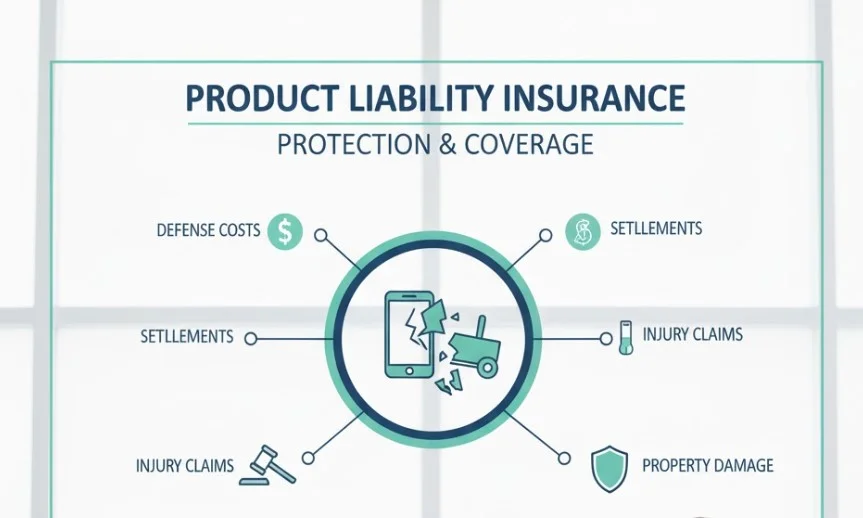
Product Liability Insurance Coverage is the foundational safety net every business involved in the stream of commerce (from garage-based creators to global corporations) must secure.
In today’s highly litigious and consumer-focused environment, a single design flaw, manufacturing mistake, or even an inadequate warning label can trigger a lawsuit that threatens to shutter even the most promising enterprise.
It’s not a luxury; it’s an indispensable shield that ensures the financial survival of your company when an unforeseen product failure leads to bodily injury or property damage for a third party.
What Exactly Is Product Liability Insurance Coverage?
Product Liability Insurance Coverage is a specialized form of commercial insurance designed to protect a business from financial loss due to legal liability claims arising from a product it manufactures, distributes, or sells.
Put simply, if a customer alleges that your product caused them harm or damaged their property, this coverage steps in to handle the enormous costs associated with defending the claim.
This protection is frequently included as part of a broader Commercial General Liability (CGL) policy under the “Products-Completed Operations” section, but for companies with significant product exposure (like manufacturers, importers, or those in high-risk sectors), a dedicated, standalone policy is often necessary for adequate limits and breadth of coverage.
The core function of this insurance is to provide a comprehensive response to three main categories of product defects that lead to a claim:
Manufacturing Defects
A Manufacturing Defect occurs when a product departs from its intended design or specifications, even though the designer exercised all possible care in the preparation and marketing of the product.
This type of defect happens during the assembly, construction, or production phase and affects a single item or a specific, identifiable batch, not the entire product line. It’s an anomaly—a mistake that slipped past quality control.
This category of defect often involves claims of strict liability, meaning the injured party only needs to prove that the product was flawed when it left the manufacturer’s control and that the flaw caused the injury, regardless of whether the manufacturer was negligent.
A claim arising from a manufacturing defect often focuses on proving a demonstrable inconsistency between the product sold and the vast majority of identical products.
Examples range from something as simple as a ladder missing a critical bolt, leading to a collapse, to complex issues like using the wrong grade of metal in an aircraft part, causing catastrophic failure.
The financial exposure under this claim type is high because it often points to a systemic failure in the quality assurance process, even if isolated, prompting intense scrutiny and potentially leading to a widespread safety alert or targeted recall of the specific defective batch.
Robust Product Liability Insurance Coverage is critical here, as it provides immediate legal defense and coverage for the subsequent damages, which can be significant if the defect caused severe injury or major property loss.
Design Defects
A Design Defect refers to a fundamental flaw in the product’s blueprint, rendering the entire line of products inherently dangerous, even when manufactured perfectly according to that flawed plan.
Unlike a manufacturing defect, which is an error in execution, a design defect is an error in conception. To prove this type of claim, plaintiffs typically rely on the “risk-utility test” or the “consumer expectation test.”
The risk-utility test requires the court to weigh the risk of the product’s design against its utility and to assess whether a safer, economically feasible alternative design existed at the time of manufacture.
If a reasonable alternative design could have reduced the foreseeable risk of harm without impairing the product’s function or dramatically increasing its cost, the design may be deemed defective. This is the most complex category of product liability litigation, often involving battles between highly paid engineering and safety experts.
Products commonly subject to design defect claims include vehicles (due to rollover risk or poor crash protection), industrial machinery (for lacking necessary guards or shut-offs), and children’s items (for pinch points or easily detachable, small parts).
Because this defect affects every unit made, a successful claim can halt production entirely and lead to massive, aggregate liability across all units ever sold.
Comprehensive Product Liability Insurance Coverage is the only defense capable of absorbing the millions in legal and expert fees required to navigate such intricate, long-term litigation that challenges the very core concept of the product.
Marketing Defects (Failure to Warn)
A Marketing Defect, often referred to as a “Failure to Warn,” occurs when a product lacks adequate instructions or sufficient warnings regarding non-obvious dangers associated with its intended use or foreseeable misuse.
The product itself may be perfectly designed and manufactured, but the way it is presented to the consumer—the labeling, packaging, and instructional material—is deemed deficient, directly leading to an injury.
The legal standard here is whether the warnings were sufficient to allow an ordinary user to use the product safely and whether the warnings were conspicuous, clear, and understandable. This is a common area of claims because manufacturers have a legal duty to warn against risks they know or should know about.
For instance, a pharmaceutical product must clearly list all potential side effects; a power tool must warn against removing guards; and a cleaning chemical must specify necessary protective equipment and ventilation requirements.
The failure to include a critical safety warning can expose the manufacturer, distributor, and retailer to liability, even if the user was arguably misusing the product, provided that misuse was reasonably foreseeable.
Claims in this category frequently involve allegations that the warnings were too small, were buried in fine print, or used technical jargon that was not accessible to the average consumer.
Securing robust Product Liability Insurance Coverage is essential for any business dealing with complex or inherently dangerous products, as the failure to warn can rapidly escalate a minor incident into a significant and costly legal defense, including paying large settlements for injuries that could have been prevented by a simple warning label.
The Critical Components of Product Liability Insurance Coverage
The essential protection offered by Product Liability Insurance Coverage is defined by three critical financial components.
These components determine how the policy responds in the immediate aftermath of a claim, during complex legal proceedings, and upon the final resolution of a lawsuit. Understanding the scope and interplay of these elements is fundamental to ensuring your business has adequate financial protection.
Comprehensive Legal Defense Costs
The most immediate and often unquantifiable benefit of Product Liability Insurance Coverage is the provision for comprehensive legal defense costs.
When a claim or lawsuit is filed—regardless of its merit—the insurance carrier typically assumes the duty to defend the insured business.
This is a massive financial relief, as litigation costs can often exceed the eventual settlement or judgment amount, especially in cases where the claim is baseless but requires a vigorous defense to prove.
These costs encompass a wide range of expenses: high-value attorney fees that accumulate over years, court filing fees, the cost of extensive discovery (document production and depositions), and, critically, the fees for expert witnesses.
Product liability cases, particularly those involving design defects, rely heavily on technical testimony from engineers, scientists, and medical professionals, whose fees can quickly run into hundreds of thousands of dollars.
In many Commercial General Liability (CGL) policies that include product liability, these defense costs are often paid “outside the limits” of the policy’s maximum liability payout.
This means that the money spent on your defense does not diminish the coverage available to pay a final settlement or judgment, ensuring that your full aggregate limit remains available for the actual damages, thereby protecting the business from the dual threat of crippling legal bills and massive liability payouts.
Settlements and Judgments for Third-Party Damages
The second pillar of Product Liability Insurance Coverage involves covering the actual damages awarded to the injured party, known as the claimant.
This coverage responds to the core financial consequence of a successful product liability claim: the payment of a final settlement (an out-of-court agreement) or a judgment (a court-ordered payment) up to the policy’s specified limits.
This component is essential because it covers the financial harm sustained by the third party, which is usually broken down into several categories of damages.
Compensatory Damages are covered, including economic losses like medical bills, rehabilitation expenses, lost wages (both past and future), and property damage (the cost to repair or replace the consumer’s property that was ruined by the defective product).
Furthermore, the policy will cover non-economic damages, which include subjective losses such as pain and suffering, emotional distress, and loss of consortium.
While most policies cover these compensatory damages, businesses should carefully review their policy for coverage of Punitive Damages—awards intended to punish the defendant for gross negligence—as these are frequently excluded or restricted by law or policy language.
By absorbing these substantial payouts, the insurance policy effectively shields the assets of the business and its owners from being liquidated to satisfy a liability claim.
Worldwide Coverage Territory Extension
For any business that sells products beyond a defined domestic market, the Worldwide Coverage Territory Extension is a non-negotiable component of robust Product Liability Insurance Coverage.
Standard general liability policies are often restricted to claims and lawsuits filed within a specific territory, typically encompassing the United States, its territories, and Canada.
The extension expands this protection to products sold globally, recognizing the reality of modern e-commerce and international distribution chains.
However, this extension is not always absolute “worldwide” coverage; it often comes with a crucial caveat concerning where the lawsuit must be filed.
Many extended policies will cover injuries that occur anywhere in the world (e.g., a product defect causing injury in another continent), but coverage is conditioned on the resulting lawsuit being filed within the standard coverage territory (e.g., a court in the United States).
For businesses with significant operations or manufacturing overseas, a specific Foreign Liability or Foreign Commercial General Liability policy may be required to cover both the injury and the resulting lawsuit if it is filed in a foreign jurisdiction.
Navigating these geographic complexities is vital because a single defective product sold online to a customer anywhere in the world can trigger a claim that, without the proper worldwide extension, would leave the business financially exposed to a costly, uninsured international defense and payout.
Who in the Supply Chain Needs Product Liability Insurance Coverage?
A common misconception is that only the original manufacturer requires Product Liability Insurance Coverage. In reality, liability laws are designed to protect the consumer, meaning that nearly every party in the “stream of commerce” can be held responsible for a defective product.
Product Liability Insurance is a crucial safeguard for nearly every entity involved in the movement of a product from raw material to the final consumer, as liability can be assigned at multiple points in the chain of distribution.
Manufacturers and Primary Producers
The Manufacturer is the entity with the highest risk exposure in the product supply chain and, consequently, has the greatest need for this coverage. A manufacturer is defined as the business that creates the finished product or substantially transforms components into a new product.
They are most often the primary target in product liability lawsuits because they are typically responsible for the design and manufacturing processes—the two core areas where defects originate.
Their liability is often based on the principle of strict liability, meaning a claimant only needs to prove the product was defective and caused injury, not that the manufacturer was negligent.
Even if a defect stems from a component part, the finished product manufacturer is generally held accountable to the consumer and must then attempt to recoup losses from the component supplier.
This exposure is compounded by the fact that they are uniquely vulnerable to large-scale, class-action lawsuits or broad recalls when a design or systemic manufacturing flaw affects an entire production run.
Therefore, their insurance must carry the highest policy limits and the broadest scope to cover not only bodily injury and property damage, but also consequential losses like business interruption for the claimant.
Component Part Suppliers
Component Part Suppliers are entities that produce raw materials, individual parts, or sub-assemblies that are incorporated into a finished product by another manufacturer. Although they may not deal directly with the end-consumer, they retain significant product liability exposure.
If a final product fails due to a defect in their supplied part—such as a faulty brake caliper causing a car accident or contaminated food ingredients causing illness—the component supplier is liable to the injured party, or, more commonly, is brought into the lawsuit as a co-defendant by the main manufacturer.
The risk is high because the failure of a small, inexpensive component can lead to catastrophic damage when integrated into a complex, high-value product.
Their insurance must specifically address the risk of “products completed operations” where their component caused damage only after the main manufacturer integrated it and the final product was placed into service.
Furthermore, they often require coverage for “products deemed non-defective” but which must be replaced or repaired due to being combined with a defective final product, emphasizing their critical and often hidden role in the liability chain.
Distributors and Wholesalers
Distributors and Wholesalers serve as the intermediaries, purchasing products from manufacturers and selling them to retailers or other distributors. While they do not alter the product in any way, they are an essential link in the chain of commerce and can still be held liable under product liability law.
In many jurisdictions, any party in the distribution chain that introduces the defective product into the stream of commerce can be sued, even if they had no practical ability to inspect for the defect.
The injured party’s attorney will often sue everyone in the chain to ensure they have a solvent party from whom to recover damages. For distributors, liability is typically only waived if they can prove they were merely a conduit and identify the original manufacturer.
If the manufacturer is foreign, bankrupt, or otherwise unavailable, the distributor is often left holding the entire liability burden.
Therefore, their insurance must cover their exposure as a stand-in defendant and provide the necessary funds for legal defense, even if they ultimately are dismissed from the suit. This is crucial for protecting them from the substantial legal defense costs and the risk of assuming full liability for an upstream party’s negligence.
Retailers and Final Sellers
Retailers and Final Sellers, which include everything from large chain stores to local shop owners and e-commerce platforms, represent the last point of contact between the product and the consumer.
Like distributors, retailers can be sued for selling a defective product, regardless of whether they were at fault for the defect itself. The legal rationale is that they are the party the consumer trusts and from whom they made the purchase.
Their liability is usually one of “seller liability” under strict liability rules. While they have the theoretical right to seek indemnification from the upstream manufacturer or distributor, they must first mount a costly legal defense.
A single defective product can severely damage the retailer’s brand and reputation, making a swift, insured response vital. For retailers who brand products as their own (private labeling), the exposure is significantly higher; they are treated legally as the manufacturer, inheriting full responsibility for design and manufacturing defects.
Consequently, even a small neighborhood store selling high-risk items (like food or over-the-counter medication) needs Product Liability Coverage to protect against both direct claims and the high cost of defending against a claim that originated further up the supply chain.
Risk Management as Your Partner to Securing Optimal Coverage
Effective Risk Management is not merely a precursor to purchasing Product Liability Insurance; it is the cornerstone of a strategic partnership with the insurer, directly influencing the availability, scope, and cost of optimal coverage.
A proactive risk management program transforms a business from a passive liability exposure into an active, preferred risk partner, leading to tangible benefits in the insurance market.
The Underwriter’s Trust and Favorable Pricing
The central role of a robust risk management strategy is to build trust and confidence with the insurance underwriter, which directly translates into favorable pricing and policy terms.
When a company demonstrates a comprehensive, documented system for minimizing product defects, the insurer views that business as a significantly lower risk to their financial exposure.
Underwriters are essentially betting on the future safety of a product, and verifiable controls—such as ISO 9001 quality management certification, detailed product testing logs, and a low claims history—act as powerful evidence that the probability of a future loss is reduced.
This allows the insurer to offer lower premiums, as their expected payout is lower, and may also result in smaller deductibles and a willingness to provide higher limits of liability.
Without such demonstrable controls, a business is simply a high-risk entity, forcing the underwriter to quote high premiums and impose restrictive conditions to compensate for the uncertainty. Therefore, risk management serves as the primary negotiating tool for cost-effective coverage.
Expanding Coverage for Critical Exclusions
A meticulous risk management program is often the key to persuading an insurer to remove or modify critical policy exclusions that might otherwise leave a business dangerously exposed.
Many product liability policies contain restrictive endorsements related to specific high-risk operations, complex international sales, or high-hazard components.
For example, a standard policy might carry an exclusion for products sold in foreign jurisdictions or for claims related to products that are part of the aviation or medical industries.
By implementing specialized controls the business can convince the underwriter that these otherwise-excluded risks are being managed responsibly.
The insurer, now confident that the risk is controlled, may agree to delete the exclusion or provide the coverage through a costly endorsement, turning a potentially catastrophic gap into a covered exposure and securing truly optimal, all-encompassing protection.
Strategic Product Lifecycle Integration and Documentation
Optimal coverage is best secured when risk management is integrated throughout the entire product lifecycle, with scrupulous documentation at every step.
This strategic approach starts at the Design Phase (e.g., using Failure Mode and Effects Analysis or FMEA to identify and design out hazards), continues through the Manufacturing Phase (e.g., rigorous quality control checks and batch testing), and extends to the Marketing Phase (e.g., legally vetted warning labels and instructions).
The resulting documentation—records of design reviews, component supplier certifications, quality control data, and formal training logs—becomes the defensive shield in a liability claim.
When a lawsuit arises, the insurer’s legal defense team relies on this paper trail to prove the company was not negligent and exercised reasonable care, which can lead to early dismissal or a favorable verdict.
This pre-emptive documentation process makes the insurer’s defense easier, cheaper, and more likely to succeed, reinforcing the partnership and ensuring the next policy renewal remains favorable, thereby creating a continuous cycle of risk-reward management.
Establishing a Cohesive Crisis Response and Recall Plan
A vital, yet often overlooked, component of risk management that significantly affects coverage terms is the establishment of a formal Crisis Response and Product Recall Plan.
Product liability claims often escalate rapidly, particularly in the age of social media, and an insurer requires assurance that the company can manage a crisis professionally to mitigate damages.
A well-rehearsed plan, detailing procedures for notifying regulatory agencies, isolating defective products, communicating with the public and customers, and managing the recall logistics, demonstrates proactive responsibility.
In the insurance negotiation process, this plan reassures the underwriter that a future claim will be contained quickly, limiting the scope of financial damage and, most importantly, reputational harm, which can often be more costly than the direct liability payout.
By presenting a documented, functional plan, the business can often secure favorable terms for related coverage endorsements, such as Product Recall Expense Coverage, transforming an operational risk into a manageable, insured event.
Conclusion
The modern marketplace presents businesses with unparalleled opportunities but also significant legal exposures. Securing the right Product Liability Insurance Coverage is a strategic investment in business continuity.
It offers peace of mind, knowing that while you focus on innovation and growth, a financial fortress stands ready to defend your enterprise against the high-stakes reality of product liability litigation. Don’t wait for a claim to discover your coverage gaps; make this essential protection a priority today.