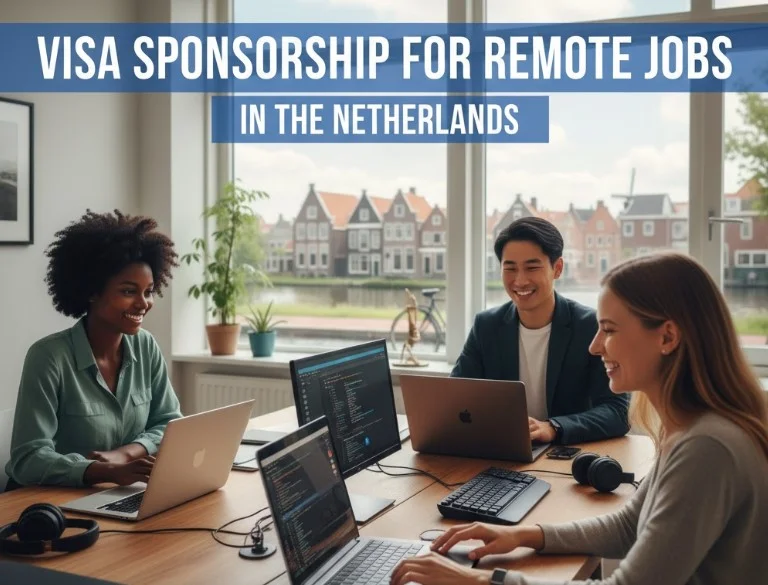
For many, the idea of Visa Sponsorship for Remote Jobs in the Netherlands might seem like a futuristic concept, but it’s very much a present-day reality for a growing number of forward-thinking Dutch employers.
As the global workforce embraces flexibility and companies seek the best talent irrespective of geographical location, the Dutch government and its businesses are adapting.
This isn’t just about temporary arrangements; we’re talking about legitimate, long-term employment opportunities where a Dutch company acts as your sponsor for a work visa, even if your primary place of work remains outside the Netherlands.
Understanding the nuances of this innovative approach is key to unlocking your potential and joining the Dutch professional scene.
The dream of living and working in the Netherlands, renowned for its picturesque canals, vibrant culture, and innovative economy, is more attainable than ever for global talent. And what if that dream also includes the flexibility of remote work?
The convergence of these two aspirations – Visa Sponsorship for Remote Jobs in the Netherlands – is a rapidly evolving landscape, offering unprecedented opportunities for skilled professionals worldwide.
Forget the traditional office commute; imagine contributing to a Dutch company from your home, anywhere in the world, with your visa status securely sponsored. This article delves deep into how you can navigate this exciting pathway, making your international career aspirations a tangible reality.
Remote Work and International Mobility for Visa Sponsorship in Netherlands
The shift toward remote work has fundamentally altered the landscape of international career opportunities, particularly in progressive economies like the Netherlands.
For skilled non-EU/EEA nationals, securing a sponsored position that allows remote work from outside the Netherlands is a complex but increasingly viable pathway.
This flexibility is largely facilitated by the Highly Skilled Migrant (HSM) visa, though its standard application is adapted to account for the cross-border employment relationship.
The Highly Skilled Migrant (HSM) Visa as the Primary Vehicle
The Dutch Highly Skilled Migrant (HSM) visa is the central mechanism for non-EU/EEA nationals seeking sponsored employment, including remote roles, with a Dutch company.
This visa is designed to attract top-tier talent into the Dutch knowledge economy. Crucially, its application process is streamlined and accelerated only when the sponsoring employer is registered as a Recognised Sponsor with the Immigration and Naturalisation Service (IND).
For remote work, the application hinges on the employment contract being legitimate and the salary meeting the annual, age-dependent threshold, even if the primary work location is outside Dutch borders. The visa grant, therefore, formalizes the worker’s status with the Dutch entity, even while they are exercising the right to work remotely from their home country or another location.
The Essential Role of the Recognized Sponsor
For any non-EU national to secure a work-based residence permit in the Netherlands, the employer must be a Recognized Sponsor by the IND.
This recognition is not a formality; it requires the company to meet strict administrative and financial criteria, and in turn, grants them the ability to use a faster, more transparent application process for their international hires.
For a position involving remote work, the Dutch company must be prepared to shoulder the responsibilities of sponsorship, which include keeping detailed records, notifying the IND of any changes (like unemployment or changes in work location), and ensuring the HSM’s salary is continually met.
The willingness of a Dutch company to undertake this administrative burden for a remote role is the first and most significant indicator of a genuine opportunity for Visa Sponsorship for Remote Jobs in the Netherlands.
Tax Domicile and the Permanent Establishment Risk
One of the most complex issues inherent in Visa Sponsorship for Remote Jobs in the Netherlands is navigating international tax law.
When an employee resides and primarily works in a country different from the Netherlands (where the employer is based), two critical tax issues arise: the employee’s income tax liability and the employer’s corporate tax liability.
Generally, the employee will be liable for income tax in their country of residence, according to that country’s tax laws and the relevant double-taxation treaty with the Netherlands.
For the employer, having an employee work remotely can, in some cases, establish a Permanent Establishment (PE) in the employee’s country of residence.
If a PE is triggered, the Dutch company could become liable for corporate tax and local employment obligations in that foreign country, which is a major factor making some companies hesitant to offer remote-from-abroad sponsorship.
Social Security and Bilateral Agreements
Beyond income tax, the question of social security coverage is paramount for remote work sponsored by a Dutch company. Social security includes contributions for state pension (AOW), unemployment (WW), disability (WIA), and healthcare.
For work within the EU/EEA, the ‘A1’ portability rule often dictates that contributions are paid in the country of residence if a ‘substantial part’ (typically 25% or more) of work is performed there.
For non-EU countries, bilateral social security agreements between the Netherlands and the remote worker’s country of residence determine where the contributions are due.
In the absence of such an agreement, the situation can become highly complex, often necessitating the employer to register and contribute to the local social security system in the employee’s residence country. This logistical and financial complexity is a key consideration for companies offering Visa Sponsorship for Remote Jobs in the Netherlands.
The Distinction from ‘Digital Nomad’ Visas
It’s vital to clearly distinguish the HSM visa for a remote employee from a ‘Digital Nomad’ visa. The Netherlands does not offer a specific, employed-work-focused Digital Nomad Visa.
The HSM visa requires a genuine employment contract with a recognized Dutch company, a fixed salary that meets the high threshold, and the employer takes on the legal and financial responsibility of sponsorship.
Conversely, a typical digital nomad visa is aimed at self-employed individuals or those working for foreign (non-Dutch) clients, and it generally places the burden of tax and social compliance entirely on the individual.
The Visa Sponsorship for Remote Jobs in the Netherlands via the HSM route provides a much greater degree of stability, professional legal standing, and mandated employer compliance, making it a distinctly superior option for long-term career growth.
Contractual Clauses and Work Location Specification
The employment contract is the bedrock of the remote HSM application. For Visa Sponsorship for Remote Jobs in the Netherlands to be approved under a remote model, the contract must explicitly detail the work arrangement.
This includes clearly stating that the primary work location is outside the Netherlands, along with a precise description of the duties.
The contract must satisfy the IND that the role genuinely requires a highly skilled individual, the salary meets the minimum threshold, and that the nature of the job makes the non-residency arrangement feasible and logical for the Dutch company.
Any ambiguity in the contract regarding the work location could trigger relocation requirements or complicate the visa approval, as the HSM is traditionally tied to residence in the Netherlands.
Logistical and Cultural Integration Challenges
While the focus of Visa Sponsorship for Remote Jobs in the Netherlands is on remote work, a purely isolated experience is rare.
Employers offering this path will likely require the employee to visit the Netherlands periodically for onboarding, team meetings, or professional development, which must be factored into the work agreement.
Beyond logistics, the remote employee must proactively address cultural integration. Dutch work culture is known for its direct communication, flatness of hierarchy, and consensus-driven decision-making.
The remote HSM must develop robust strategies for communication and collaboration across time zones and cultural differences to successfully integrate and contribute to the team, mitigating the risk of professional detachment that can often accompany international remote roles.
Visa Sponsorship for Remote Jobs in the Netherlands
The Dutch immigration system, managed by the Immigration and Naturalisation Service (IND), is primarily geared towards bringing highly skilled workers to reside in the Netherlands. Therefore, securing visa sponsorship for a job that is permanently remote from outside the Netherlands is highly complex and rare.
The most viable options that involve a Dutch employer sponsoring a non-EU/EEA national’s work are still largely anchored to the expectation of the employee eventually establishing residence in the Netherlands, or working remotely for only a transitional period.
1. Highly Skilled Migrant (HSM) Permit with Initial Remote Work
The Highly Skilled Migrant (Kennismigrant) permit is the most common and streamlined route for non-EU nationals to be sponsored by a Dutch employer.
While the primary purpose of this permit is to allow the worker to live and work in the Netherlands, some Recognized Sponsors may initially allow the employee to work remotely from their home country for a defined, temporary period.
This arrangement is typically a transitional phase to facilitate onboarding, relocation planning, or to accommodate short-term logistical issues before the move.
The core requirement of the HSM scheme is that the employee must have an employment contract with a Recognized Sponsor in the Netherlands and meet a high, age-dependent minimum salary threshold (indexed annually).
The challenge for a purely remote arrangement is that the IND’s focus is on the migrant’s contribution to the Dutch knowledge economy in the Netherlands.
Allowing long-term remote work from abroad creates significant administrative and compliance issues for the employer, especially concerning tax obligations and social security contributions in the foreign country, which can create a Permanent Establishment (PE) risk for the Dutch company.
Therefore, while initial remote work may be permitted, the employer’s ultimate goal and the spirit of the visa is for the employee to relocate to the Netherlands and apply for the residence permit upon arrival.
2. EU Blue Card for High-Level Qualifications
The EU Blue Card is a European-wide residence and work permit for highly qualified non-EU nationals. It functions similarly to the Dutch Highly Skilled Migrant scheme but has slightly different and often higher salary and educational requirements (it explicitly requires a higher education degree of at least three years).
Like the HSM permit, the EU Blue Card is intended to facilitate the mobility and residence of a highly qualified professional within the EU.
While the Blue Card offers greater intra-EU mobility (making it easier to move and work in another EU member state after 12-18 months), it does not directly facilitate long-term, permanent remote work from a non-EU country.
The Dutch employer must still be prepared for the employee to move to the Netherlands. The primary advantage of the Blue Card for remote-friendly roles is that its purpose is defined by high qualifications, which are often found in modern, highly flexible industries (like IT and tech) that are more amenable to remote work models.
However, the non-EU country remote arrangement faces the same tax and social security complexities as the HSM permit, often making it only feasible as a temporary initial measure before the worker establishes residency in the Netherlands.
3. Intra-Corporate Transferee (ICT) Permit for Multinational Employees
The Intra-Corporate Transferee (ICT) permit is a specialized residence permit based on an EU directive, and it is relevant only to employees of a multinational group of companies.
This option is not a general route for remote job seekers but applies to a foreign employee who is being transferred from a company branch outside the EU/EEA to a branch of the same group in the Netherlands. The permitted roles under this scheme are restricted to managers, specialists, or trainee employees.
For remote work, the ICT permit could theoretically apply to a situation where the Dutch entity is the recipient of the transfer, but the employee remains in their home country to complete a specific, temporary assignment that is globally managed by the Dutch branch.
However, the ICT permit is explicitly a temporary arrangement, with a maximum stay of three years for managers and specialists (one year for trainees).
The transfer agreement that forms the basis of the application must outline the duration of the transfer and confirm that the employee will be able to return to a branch of the company outside the EU/EEA upon the end of the transfer period.
This framework fundamentally contradicts a permanent, indefinite remote work arrangement, as its legal purpose is to regulate physical and temporary corporate transfers into the Netherlands.
4. Employer of Record (EOR) / Payroll Company Solution
A more practical, albeit indirect, solution for true long-term remote work from a foreign country is through a third-party service provider known as an Employer of Record (EOR) or a payroll company.
In this scenario, the Dutch company (the client) effectively outsources the employment relationship to the EOR, which becomes the legal employer of the remote worker in their country of residence.
The remote worker is employed by the EOR under a local contract in their home country, which means no Dutch visa sponsorship is required from the Dutch client company. The EOR takes on all the local HR, tax, and labour law compliance burdens in the employee’s country, eliminating the PE risk for the Dutch client.
This is not a visa sponsorship option in the traditional sense, but it is the most common corporate solution that allows a Dutch company to employ a foreign national for a remote job abroad legally.
The drawback for the employee is that they do not receive a Dutch work permit or the associated benefits (like the potential to apply for the 30% tax ruling), and their ability to relocate to the Netherlands is not facilitated by this employment.
Navigating the Visa Application Process (with your Sponsor)
The Netherlands adopts a sponsor-driven immigration model, particularly for the Highly Skilled Migrant (HSM) scheme. This means the employer, acting as the Recognized Sponsor, is the primary applicant and manager of the process, rather than the employee.
Navigating this process requires close collaboration between the foreign national and the Dutch company, with the sponsor holding the majority of the legal responsibilities and administrative control.
The Role of the Recognized Sponsor and the Fast-Track Procedure
The fundamental step in the process is securing employment with a company that has been officially acknowledged by the Immigration and Naturalization Service (IND) as a Recognized Sponsor (or erkende referent).
This designation is not automatic; the employer must apply for and maintain this status by demonstrating financial solvency, continuity, and compliance with all relevant Dutch labour and tax laws.
The significant advantage of this system is the fast-track procedure. While a standard visa application can take up to 90 days, applications submitted by a Recognized Sponsor are targeted for a decision within a mere two weeks. This accelerated timeline is a major draw for international talent and is the reason the HSM permit is so popular.
The sponsor’s role is crucial as they initiate the combined application for the entry visa (MVV, if needed) and the residence permit, submit most of the documentation, and are legally obligated to inform the IND of any relevant changes to the employee’s status or employment conditions throughout the duration of the permit.
Documentation Gathering and Compliance Check
Although the sponsor handles the submission, the employee is responsible for promptly providing all necessary personal documentation.
This typically includes a copy of a valid passport, proof of meeting the professional qualifications (such as degrees, often requiring evaluation by Nuffic for foreign diplomas), and, in some cases, the completion of an Antecedents Certificate declaration.
All foreign official documents, such as marriage certificates or birth certificates for accompanying family members, must often be legalized or apostilled in the country of origin and translated by a sworn translator if not already in Dutch, English, German, or French.
The sponsor, on their end, provides the signed employment contract which explicitly confirms the gross monthly salary meets the yearly indexed HSM thresholds.
This combined documentation is meticulously checked by the IND, and any missing, incorrectly formatted, or unlegalized document will lead to delays or a request for additional information, thereby extending the two-week target processing time.
Combined Application Submission and Biometrics Appointment
For applicants who require a provisional residence permit (MVV) to enter the Netherlands (nationals of most non-EU/EEA countries), the Recognized Sponsor submits a single, combined application to the IND for both the MVV and the residence permit simultaneously.
This is known as the Entry and Residence Procedure (Toegang en Verblijf or TEV). Once the IND approves the application, they notify both the sponsor and the Dutch embassy or consulate specified in the application.
The final step for the applicant abroad is to make an appointment at the designated Dutch diplomatic post to provide their biometric data (fingerprints and photo) and have the MVV visa sticker placed in their passport.
This MVV then acts as the authorized entry visa, valid for 90 days, allowing the highly skilled migrant to travel to the Netherlands and subsequently collect their physical residence permit card upon arrival.
Post-Arrival Formalities and Sponsor Obligations
The visa process does not end with entry into the Netherlands; there are mandatory post-arrival formalities.
The first critical step is to register with the local municipality (gemeente) within a specified period (usually five days of moving into an address) to be entered into the Municipal Personal Records Database (BRP) and obtain a Citizen Service Number (BSN).
The BSN is essential for all administrative matters, including opening a bank account and applying for the 30% tax ruling. Furthermore, the sponsor has ongoing legal obligations throughout the employee’s residency.
These obligations include maintaining a complete record of the employee’s documentation for five years, monitoring that the employee’s salary continues to meet the applicable threshold, and immediately reporting any relevant changes to the IND, such as the termination of employment.
Failure by the sponsor to meet these obligations can result in heavy fines and, in serious cases, the loss of their Recognized Sponsor status, which would negatively impact the employee’s residence permit.
A Glimpse into the Future
The trend towards Visa Sponsorship for Remote Jobs in the Netherlands is indicative of a broader global movement. As technology advances and companies become more agile, geographical barriers to talent acquisition are diminishing.
The Netherlands, with its progressive outlook and strong economy, is at the forefront of this evolution. While the legal and administrative frameworks are still catching up to the speed of technological change, the pathway for highly skilled migrants to work remotely for Dutch companies is becoming clearer.
For aspiring international professionals, this means a wider world of opportunity. It means the possibility of contributing your skills to a leading European economy, benefiting from a robust professional environment, and gaining valuable international experience, all while maintaining the lifestyle and location that best suits you.
Conclusion
Securing Visa Sponsorship for Remote Jobs in the Netherlands is an ambitious yet achievable goal for highly skilled professionals. It requires diligent research, a compelling application, and a clear understanding of the administrative and logistical complexities. However, for those who successfully navigate this path, the rewards are significant: a fulfilling career with a Dutch employer, the security of a work visa, and the unparalleled flexibility of remote work.